These are More that Just Fun Guys
The Wood-Wide Web (WWW)
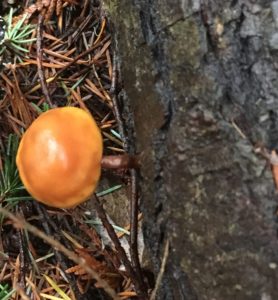
The other day I went to go for a run in the forest near our home. It was difficult to gain any real momentum, and thus and that steady-elevated heart beat that is the essence of aerobic exercise, because I found myself stopping time and time again to admire and take photos with my phone’s camera of the amazingly gorgeous mushrooms. My wife and I have found that this autumn the variety of fungi on display locally is particularly stunning. The range of color, shape, and size just makes you smile. I can’t help but exclaim when I see the intensely pure orange of this little guy for example, it’s delicate stem growing out of a fallen tree, perpendicular to the ground – its shiny orange cap a tiny umbrella facing up.
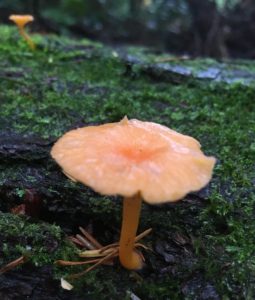
And here another orange mushroom, with more of a parasol cap, a beautiful relief against the moss on the bark from which emerged.
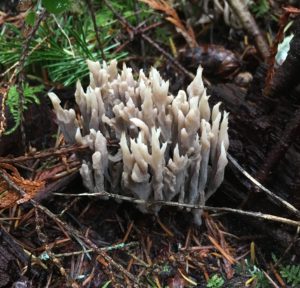
Or take this miniature coral reef-like specimen; what a sight! It really is a pop-up scene because one day they are here, but before long, like say in a week, the whole thing collapses and melts back into the forest floor, leaving not a trace.
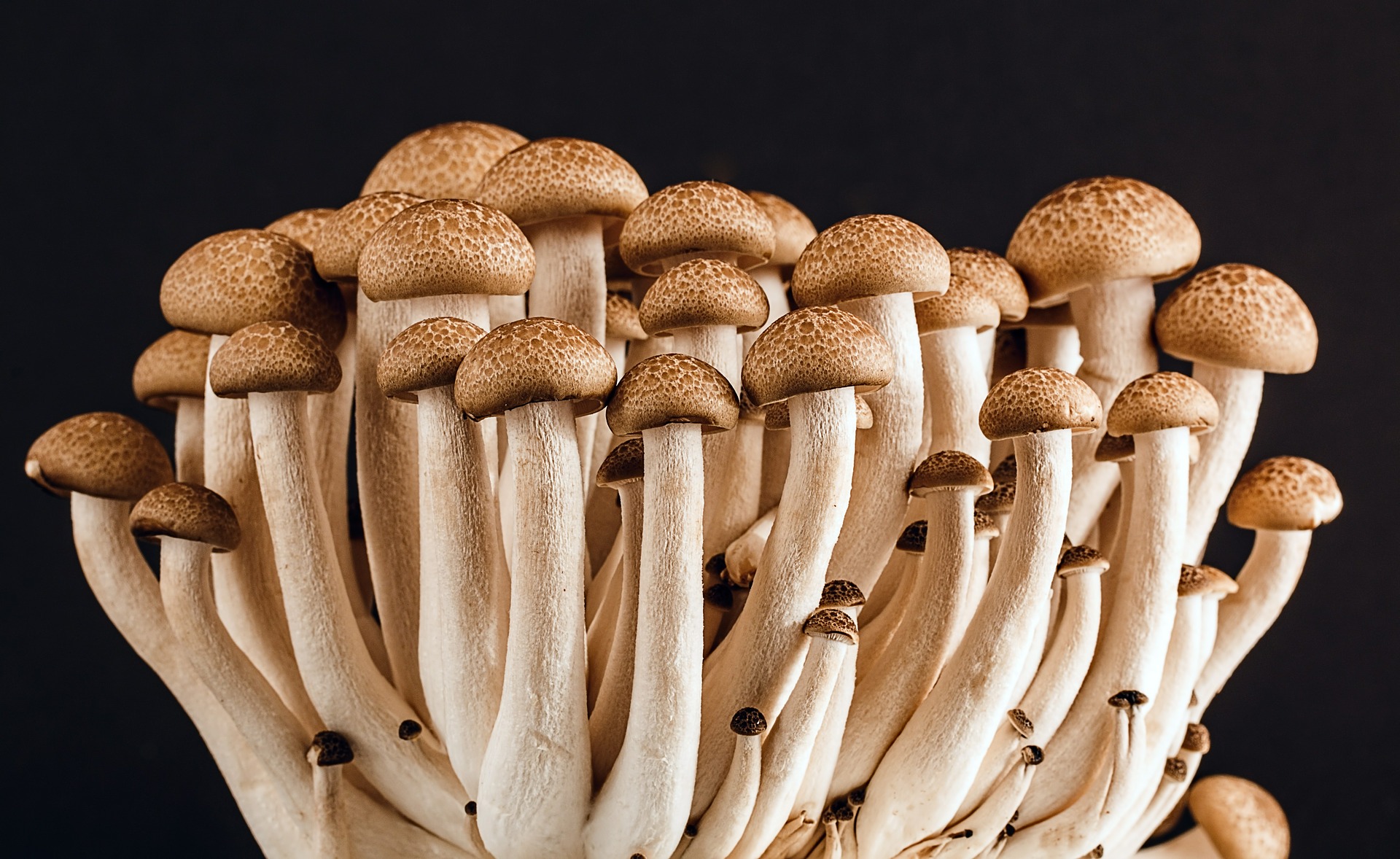
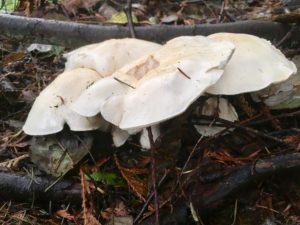
My final example is a most delicious looking group of pristine white, almost dough-like texture– a very cozy looking foursome:
There were many other species along the trails, too numerous to show here; I just wanted to show a few. And although I love learning the names of interesting phenomena, I deliberately did not look up these “fun guys” to see their Latin and common names and the minutiae of each of their kind; I wanted to experience them as I saw them, without projecting all kinds of not-present-in-this-moment details on them. They were a joy to behold, and yes, I did photograph them for further enjoyment. But I did so for this little article. For there is a greater reality at work here. You see, the mushrooms that we see are only the “fruiting bodies” of the species; underneath the visible layer of the forest floor there is a network of very fine white threads, called myecelium. This network of tiny and delicate threads are in fact the communication system of the forest. If we think of a forest as not just an ecosystem, but a group entity unto itself then the myeceliium is the nervous system of this forest-being. This was only recently brought to the world’s attention by a Canadian forestry professor at the University of British Columbia, Dr. Suzanne Simard. Using radioactively marked isotopes she demonstrated in the 90’s that a tree not only communicates with members of its own species and that of other species, but is able to send valuable food molecules to a fellow forest member. She has demonstrated that the myecelial network that runs everywhere in the forest is able to break and dissolve anything and everything in and on the forest floor and passes these harvested nutrients and minerals to trees in exchange for sugar molecules, which in turn sustains the fungal network. So when you see a mushroom you are seeing only the tip of the iceberg; the real fungal presence in in the soil, so densely in fact that a cubic inch of forest soil contains enough length of threads to go around a football field. In addition to publishing her findings in scientific journals –which gave rise to the term “The Wood-wide Web in academic forestry literature– Suzanne Simard has given numerous talks, including TED talks available on YouTube, NetFlix, etc. To learn more about trees’ communication systemsms you might want to read Peter Wohlleben’s book The Hidden Life of Trees. You’ll never see a tree in the same way ever again, it is truly astounding and joyfully perplexing.
But back to the fruit-bodies, those mushrooms that we see not only in the forests and fields, but with an increasing variety in our local supermarkets. Not only are many of them exquisitely flavorful, but there are hundreds of species that have powerful medicinal powers. It is literally true that one fungus can kill yet another one can furnish you a long and healthy life. In Asia this has been known for many centuries if not eons, but the scientific study of the healing properties of mushrooms is a relatively new enterprise, one that is gaining aficionados and momentum at great speed. In North America we are fortunate to have, in Olympia, Washington, one of the world’s greatest mycology-gurus, Paul Stamet. Not only has he learned to grow just about every variety of yummy and medical mushroom, but is also involved in remediation of ecosystems destroyed by toxic exposure or natural disasters. It turns out that fungi are the “first responders” in regrowing a damaged field, forest or crop, and he and his research teams have learned which species are best at removing which toxins and rebooting an ecosystem. Star Trek fans may know from the latest incarnation of the franchise that the spaceship’s engineer is named Paul Stamet, in honor of the great mycologist, and the ship’s engine works using a “spore-based” technology that can move the ship to anywhere in the universe via a myeceliium-type space-time network. OK, I don’t fully get it, but I get what they’re hinting at: as below, so above. The micro-network in the earth is a reflection of general pattern in the nature of the universe to organize matter and energy in networks, fields. Well, that takes me well beyond my personal experience and knowledge so I better sign off lest my readers think that I’ve eaten some mushrooms of the psychoactive variety. But there’s magic in them woods, that’s for sure.
A conch or shell-like species that is one of organisms that turn the log it is fruiting on to mulch, food for the next generation of trees.